Payroll Compliance API vs In-House Build: What Australian Enterprises Should Do Next

If payroll accuracy and auditability are critical and your roadmap is crowded, a payroll compliance API is the faster, lower-risk path to award interpretation automation. Build in-house only when you have deep IR expertise, a dedicated rules engineering team, and the appetite to maintain versioned logic for years.
Why this decision matters now
Australian payroll has become a board-level issue. Underpayments rarely stem from one mistake. They come from the intersection of complex awards, fragmented data and manual decisions. Whether you’re modernising in-house payroll systems or upgrading to payroll compliance software Australia trusts, your choice is simple:
- Compose compliance through an API (OAHI’s Pay Rules) and keep your stack intact, or
- Construct a rules engine, data pipelines, tests, and governance in-house—and keep them current forever.
Option A: The case for a payroll compliance API
A payroll compliance API externalises the hardest parts of compliance so you can focus on experience, cost control and reporting.
Advantages
- Speed to value: Go live in weeks, not quarters.
- Versioned rules: Award updates and agreement versions are managed and testable.
- Audit-ready outputs: Itemised calculations with traceable decision paths.
- Composable architecture: Drop-in for HRIS, T&A and payroll—no rip-and-replace.
- Elastic scale: Handle peaks (seasonal hiring, retros) without tuning local infrastructure.
- Lower total cost of ownership (TCO): Avoid standing up a permanent rules engineering team.
Where it fits
- You’re standardising outcomes across multiple brands/systems.
- You want award interpretation automation now, but can’t stall other initiatives.
- Your security team prefers well-governed vendor components over bespoke logic.
Option B: The case for an in-house build
Building your own engine gives maximum control—but demands ongoing investment.
Advantages
- Full customisation: Niche rules and edge-case handling exactly as you want.
- Local optimisation: Tight coupling to your data model and workflow.
- IP ownership: Useful if payroll is a core product capability (e.g., you’re a software vendor).
Hidden costs and risks
- Rules drift: Awards, EAs and policies change. Your logic must keep pace.
- Test debt: You’ll need golden datasets, unit tests, regression suites and sandboxes.
- People risk: Rules engineers and IR specialists are scarce and expensive.
- Audit overhead: You must document every decision path and maintain artefacts.
- Throughput & resilience: Idempotency, retries, bulk processing and backfills aren’t “extras”—they’re table stakes.
What “award interpretation automation” really requires
Whether you buy or build, these capabilities are non-negotiable:
- Executable rules with precedence (award vs EA, site/role/classification overlays)
- Version control & effective dates (past, present, scheduled future changes)
- Transparent calculations (ordinary, penalties, OT, allowances, loadings)
- Scenario & BOOT testing (per shift and per pay period)
- Sandboxes (promote rules safely after regression testing)
- Bulk & real-time (APIs for approvals; batch for retros and audits)
- Evidence & observability (trace IDs, logs, metrics, exception queues)
- Security & privacy (PII minimisation, encryption in transit/at rest, access controls)
A mature payroll compliance API should tick all eight from day one.
TCO: Build vs Buy (what’s usually underestimated)
Up-front (Build):
- Rules engine design, domain modelling for awards/EAs
- Pipelines for ingestion, transformation and reconciliation
- Golden datasets, fixtures, regression harness, CI/CD
- Security reviews, performance rigging, failover
Ongoing (Build):
- Rule changes, annual updates, EA renewals, local policy tweaks
- Support for retros, audits, incident handling, knowledge transfer
- Tooling for diffing rule versions and promoting releases
- Capacity planning for peak runs and backfills
Buy (API):
- Subscription + usage
- Integration and initial mapping
- Internal controls & reporting (lighter, but still required)
Unless your team is already equipped with a rules platform, purchasing one is almost always the better option for time-to-assurance and total cost of ownership (TCO).
Reference architecture: payroll compliance API in action
Flow
- T&A or HRIS sends an approval event with timesheet + attributes.
- Pay Rules(API) applies the correct rule set (award/EA version + overlays).
- Response returns itemised outcomes (ordinary, penalties, overtime, allowances) with a traceable breakdown.
- Payroll consumes results; Pay Pulse (optional) validates exceptions and runs BOOT evidence.
- Data warehouse stores decisions for analytics and audits.
Decision matrix (use this in steering committee)
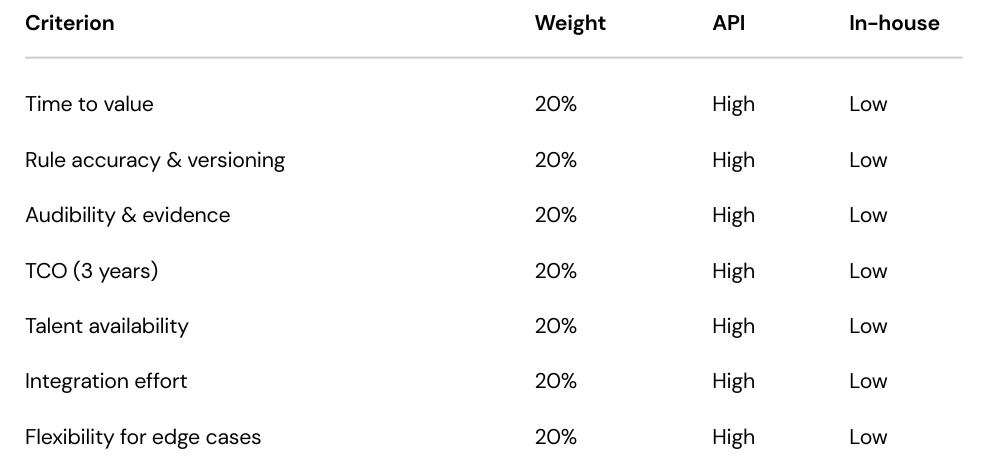
If “Time to value," “Auditability” and “TCO” matter most, the payroll compliance API path generally wins.
When an in-house build actually makes sense
- You’re a software provider and pay calculation is your product’s core IP.
- You already employ a specialist rules team and have a mature test harness with golden datasets.
- Your estate is highly bespoke and would otherwise need extreme customisation.
If all three are true, the build can be justified. Otherwise, you’re likely taking on long-term platform risk for short-term control.
Want a concrete view of API vs build for your environment? We’ll map one award, run your golden dataset through Pay Rules, and show side-by-side outcomes, evidence and the integration plan. So, you can decide with confidence.