Retail Workforce Management Software: Rostering and Compliance Done Right

Retail moves fast. Trading hours shift, promotions spike demand and casual availability changes weekly. When rosters and pay rules do not line up, costs blow out and trust erodes. The answer is retail workforce management software that treats compliance as a first-class feature, not an afterthought. Done well, you publish fair rosters, control labour spend and produce audit-ready payroll outcomes every pay cycle.
This guide shows how to standardise retail rostering compliance, reduce rework in payroll compliance for retail, and meet expectations for Fair Work compliance software without replacing your core systems.
Why retail rostering is a compliance risk magnet
- Volatile demand across weekdays, weekends, late nights and public holidays
- Casual-heavy teams with frequent availability changes and swaps
- Store and DC variations in classifications, allowances and higher duties
- Short lead times for promotions and events that alter coverage needs
- Manual overrides at store level that bypass controls
When these realities meet complex award rules, inconsistency creeps in. Exceptions become normal. Pay queries rise. The fix is to move compliance upstream into rostering and approvals.
What great retail workforce management software should include
- Forecast-linked rostering
Build rosters from sales, traffic or task forecasts, then price shifts in real time to keep to budget. - Rule-aware scheduling
Enforce minimum engagement, breaks, consecutive days and fatigue thresholds before publishing. - Skills and higher duties
Allocate qualified staff and apply higher duties only for the relevant portion of the shift. - Approval-time validation
Check each shift against the correct award or agreement before it hits payroll. - Employee self-service
Availability, shift offers and swap rules that avoid ad-hoc texting and side deals. - Exception workflow
Queue exceptions with clear actions for managers and payroll, tracked to resolution. - Open APIs
Connect to HRIS, Time and Attendance and payroll so you do not need to re-platform.
Compliance foundations: from roster to pay
To get retail rostering compliance right, make the rules executable and auditable.
- Award interpretation engine converts time data and attributes into itemised outcomes: ordinary hours, penalties, overtime tiers and allowances.
- BOOT test automation runs the Better Off Overall Test per shift or period where required and stores evidence.
- Version control and effective dates ensure the calculation used last quarter can be reproduced exactly.
- Bulk processing handles retros, audits and agreement changes without weeks of manual effort.
This is the baseline for credible Fair Work compliance software in retail.
Common retail scenarios and how software should handle them
Late close, early open
Warn on minimum rest breaches and block publish if the threshold is not met. If approved by exception, capture evidence and price correctly.
Public holidays and substitutes
Apply the correct penalty or substitute day rules and keep the breakdown with the shift.
Missed meal breaks
Detect and apply paid break rules or penalties automatically, with an exception for manager review.
Acting store manager
Apply higher duties only to the period performed, not the whole shift, and record the reference.
Multi-site travel or split shifts
Attach the right travel or site allowance and minimum engagement logic without manual edits.
Distribution centres
Handle night work, weekend penalties and overtime thresholds at volume during peak seasons.
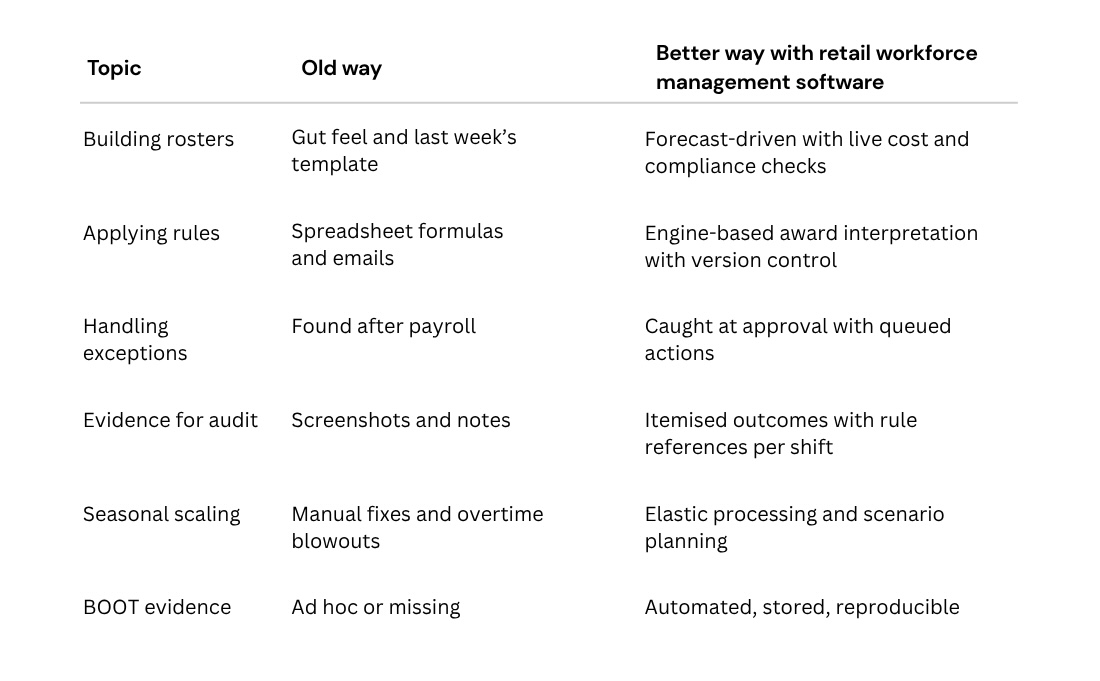
Old way vs better way
Metrics that matter in retail
- Roster-to-pay variance as a share of labour cost
- Exception rate at approval by store and rule type
- Time to resolution for manager and payroll queues
- Overtime percentage and trend by region
- BOOT pass rate with cohort breakdowns
- Pay queries per 100 employees pre and post go-live
- Retro percentage and value after rule updates or audits
These measures show whether payroll compliance for retail is improving, and where to focus.
Conclusion
In retail, accuracy protects margin and brand. With rule-aware rostering, approval-time validation and audit-ready payroll outcomes, you can meet demand, reduce rework and uphold Fair Work compliance every week. That is the promise of modern retail workforce management software when it is implemented well.