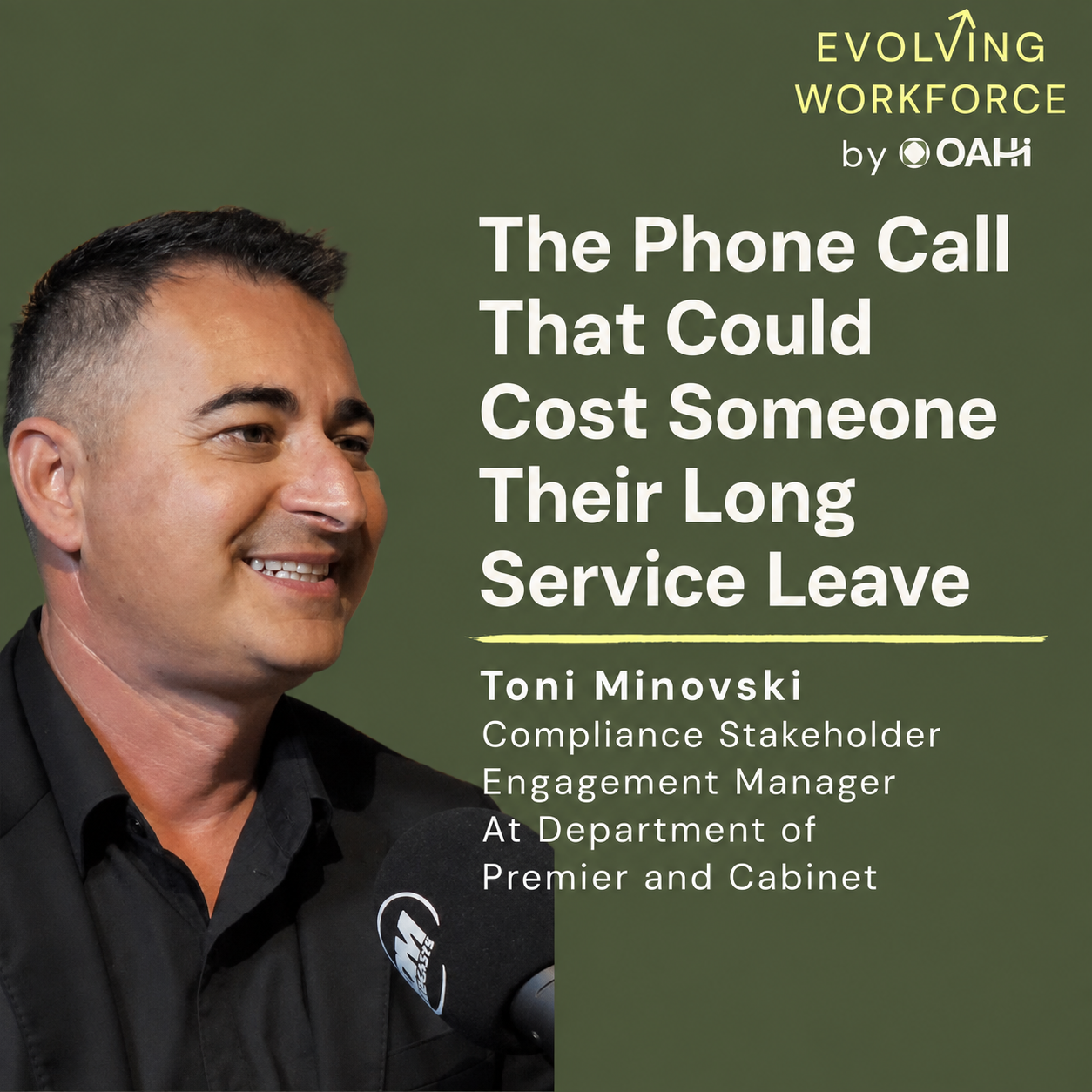
The Phone Call That Could Cost Someone Their Long Service Leave
A sixteen year old casual calls in to say she can't work for four days because of exams. Whoever takes that call is making a decision that could affect her long service leave, whether they realise it or not.
In New South Wales, Australia, a casual employee's absence doesn't have to be dramatic to matter for long service leave. It just has to go unassessed. A gap in shifts, a stretch of unavailability, a period of unpaid leave: each of these can affect how continuous service is calculated, and each one is usually handled in the moment by a frontline manager with no payroll training and no system prompting them to think about long service leave at all.
That gap, between an ordinary rostering conversation and a question that can matter for years, is where I see long service leave compliance most often fail.
What counts as a service affecting event
A service affecting event is any change in an employee's employment, an extended absence, a shift from casual to part-time, a period of unpaid leave, that can affect how their length of service is calculated for long service leave purposes. Getting the record of that event right, at the time it happens, matters far more than most employers realise, because it's very hard to reconstruct accurately later.
Here's the example I use most often. A small retail business gets a phone call from a sixteen year old casual employee. She's unavailable for the next four days because she has exams. Our guidance now states that an absence like that doesn't break her service, but it also doesn't count as service. The eighteen year old manager taking that call is the one who has to record it, and that conversation, what was actually said, what was actually meant, is something only a human can interpret. I can't see AI being involved in that aspect right now.
Why long service leave is one of Australia's most exposed compliance areas
I put this down to three things.
- Regulatory complexity. At the Australian Payroll Summit, one of the speakers told us the Australian industrial relations landscape is the third most complex in the world. I think that's right.
- An old law with thin case law. The Long Service Leave Act is 71 years old, and there simply isn't much case law to clarify how it applies to a modern, casualised workforce. That's part of why we brought out new guidance.
- Reliance on assumption over legislation. I still hear people say things like "you've got to give someone three warnings" or "you're entitled to overtime" or "long service leave kicks in after seven years." None of that is in the Fair Work Act. It's the pub test, what someone heard at the coffee shop, treated as settled fact.
We released updated long service leave guidance on 1 March, specifically to help payroll professionals interpret the Act, including how it treats casual employees who take extended absences. Part of the reason we did that is the number of high-profile cases where employers have gotten this wrong.
The real cost: reconstruction, not remediation
Long service leave rarely fails all at once. It fails quietly, over years, in small unassessed moments like that exam phone call, until an employee approaches a service milestone and someone has to go back and work out, often years later, exactly what happened and why.
When it isn't caught early, I see two things happen:
- Reputational risk. If you're not paying a long serving employee their correct entitlement, it doesn't make you look good. It hurts, and it should.
- Operational cost. Reconstructing years of service history after the fact, and assessing gaps in the record with none of the original context, is a lot harder and more expensive than capturing enough detail at the time.
That's part of why we run a self reporting channel for long service leave. If you're having difficulty, or you think you've paid people incorrectly for years and don't know how to fix it, let us know. I can come out, look at what's happening, and in some cases resolve it then and there. There might be a need for further remediation or an audit, and we'll be part of that too. We're not out there with a big stick. We're out there to help organisations get it right.
Where AI helps, and where it doesn't
A lot of organisations have told me they've got the perfect AI-powered long service leave calculator. I hope they do. I haven't tested any of them myself, and some of what I've seen looks genuinely impressive. But I'll say this clearly: you always need the human.
The exam phone call is exactly why. Interpreting what was actually said and meant in that specific conversation, and capturing it accurately at the point it happens, isn't something I can see AI doing right now. The same goes for the stakeholder engagement work I do, building relationships so organisations understand a genuinely complex piece of legislation. You can go to AI for a response, and some of them are pretty good at sounding helpful. But there's still real value in having a relationship with a person you can talk this through with.
My underlying point is that any tool is only as reliable as the data going into it. The data that goes into any system is the most important thing, whether that's long service leave, industrial relations compliance more broadly, or record keeping generally. A calculator, however well built, can't correctly assess a service affecting event that was never captured accurately at the source. If your organisation is using one of these tools, please make sure a human checks the calculation. I'd rather we avoid the mistake altogether.
What good long service leave record keeping looks like in practice
The organisations I see getting this right in Australia aren't the ones with the most sophisticated calculator. They're the ones that treat every service affecting event as worth capturing properly the first time, with enough detail to actually assess it later, rather than something to piece together retrospectively from memory and rostering notes.
In practice, that means:
- Giving frontline managers, the people actually taking calls like the exam leave example, a simple and consistent way to record what happened and why, at the time it happened
- Capturing that record in a format payroll can actually use years later, not a note buried in a rostering app or a manager's memory
- Treating long service leave record keeping as a workforce management problem first, and a calculation problem second
What I'd ask employers in Australia to do next
If you have an award covered or casual heavy workforce, particularly in retail, hospitality, healthcare or construction, the question I'd ask isn't "do we have a long service leave policy." It's this: if an employee's service history were challenged today, could you show what actually happened during every gap in their engagement, and why, rather than reconstructing it from memory under pressure.
Toni Minovski is the Industrial Relations Stakeholder Manager for New South Wales Premier's Department, where he works directly with businesses to translate industrial relations legislation, including the state's long service leave laws, into practical, compliant outcomes. He is a regular speaker at industry events including the Australian Payroll Association Summit. This piece is adapted from his conversation with Dave Kenyon on the OAHI Evolving Workforce podcast.
Get your record keeping right at the source, and assessing long service leave gets a lot simpler when the time comes. Systems such as OAHI's Time & Attendance and Award Interpretation are built around that principle, capturing time and attendance of staff accurately at the point they occur so the reconstruction problem never has to happen in the first place. Find out more at oahi.io.